
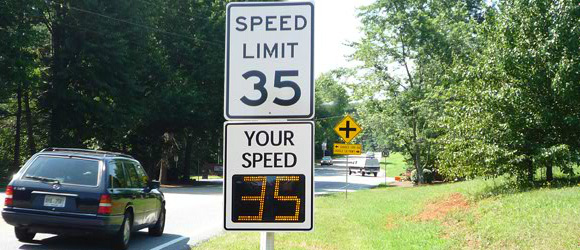
With the release of Radarsign’s “Best Practices in School Zone Traffic Calming” guide, it is now much easier to implement a comprehensive school zone traffic calming plan just got whole a lot easier. Radarsign™ is America’s official school zone safety partner. This guide provides guidance to community leaders and traffic management professionals to plan and implement an effective school zone traffic calming plan.
View PDF
White Papers
Speeding, Distracted Driving and Radar Speed Signs:
The Science that Connects Them Distracted driving is one of the top reasons why drivers speed. Yet, we often overlook the relationship between driver speed and driver distraction as an opportunity to solve the distracted driving epidemic. This is probably because the majority of distractions come from within the vehicle. Mobile phones, radios, passengers, a […]
SPEEDING ON MAIN STREET
Best Practices for Traffic Calming in Small Towns When you think of small towns and law enforcement, do you think of fictional towns like Mayberry, North Carolina, or Hawkins, Indiana? Or do you immediately think of your own town? It’s not surprising if you first thought of your hometown when you consider that one in […]
Radarsign Product Line Delivers “Must Have” for Municipalities
When municipalities need traffic calming solutions for multiple locations (each unique in their circumstances), it is ideal to find a single vendor that can deliver the market-leading technologies to meet each condition. Radarsign’s robust product line is the driving factor behind a spike in sales to municipalities across the U.S., including the Town of North Hempstead, New York.
Beyond GPS: Closing the Speed Compliance Gap on Corporate Properties
GPS technology, which can track and monitor the travel speeds and locations of corporate vehicles, may be responsible for a gap in street safety on corporate campuses with heavy fleet traffic. How can compliance to posted speed limits be ensured, especially at busy entry and exit points, which see high concentrations of traffic 24 hours a day? This two-page white paper from Radarsign—-the manufacturer of the world’s first armored driver feedback sign—-examines the gaps and the solutions.
Traffic Calming in HOAs, Neighborhoods and Residential Areas
As HOAs and other community leaders evaluate traffic-calming options, more and more are discovering that radar speed signs are the best solution. Also called driver feedback signs, these devices have grown in popularity over the past decade because they are silent, effective and cost-efficient. In this whitepaper, Radarsign® addresses some of the most common questions about radar speed signs.
View PDF
Best Practices Regarding Driver Speed Signs
Radar driver speed signs have grown in popularity over the past decade because they are quiet, effective, cost-efficient and well-received by drivers and communities alike. The increasing demand for traffic-calming solutions that offer flexibility in size, location/mobility and power options has caused some confusion for those searching for a solution that fits their needs. View PDF
The Science Behind Radar Speed Signs as Neurobehavioral Activators
“Familiarity breeds inattention” says RoadtripAmerica.com, citing inattentive drivers as the most common source of collisions. The behavior, described as “driving on autopilot” or “highway hypnosis,” is the focus of a study of drivers’ habits. Understanding these behaviors and the Reticular Activators’ impact on Beta/Theta brain activity can help alter driver behavior. View PDF
Slowing “Big Rigs” with Driver Feedback Signs
Using Driver Feedback Signs as Part of an Overall Traffic-Calming Plan
Cultivating safe communities is a primary goal for both municipalities and police departments across the nation and around the world. Traffic safety—especially speed enforcement, traffic calming and driver, pedestrian and cyclist safety—is a major concern for national, state and local DOT, law enforcement jurisdictions and court systems. View PDF